
See Sofia Differently: A Self-Guided Graffiti Tour of Sofia
If you want to look a little more closely at Sofia’s walls, I’ve put together a short walking route based on some of the pieces I came across during my own wanderings.
This isn’t intended to be the Sofia street-art tour. Instead, think of this as a trail through some of the works that caught my attention, arranged into a route that makes sense on foot.
I’ve deliberately ordered it so you move through the city rather than constantly doubling back. It begins in the centre, moves through the Maria Luisa and Serdika area, into the old Jewish Quarter and KvARTal, before finishing further north in Hadzhi Dimitar.
Allow a couple of hours if you’re walking briskly, considerably longer if, like me, you are inclined to stop every few minutes to photograph something, peer down a side street or wonder what a particular piece might be trying to say.
Stop 1: Parked Life
Han Asparuh 23
I would start on Han Asparuh Street, where an enormous mural by Belgian artist Gijs Vanhee stretches up the side of a building.
Called Parked Life, the work was created in July 2022 as part of Belgian Days and the Visionary Foundation’s urban-art programme. It’s full of Vanhee’s characteristic bird-headed figures, stacked cars, trees and little scenes that seem to belong simultaneously to the real city and some strange parallel version of it.
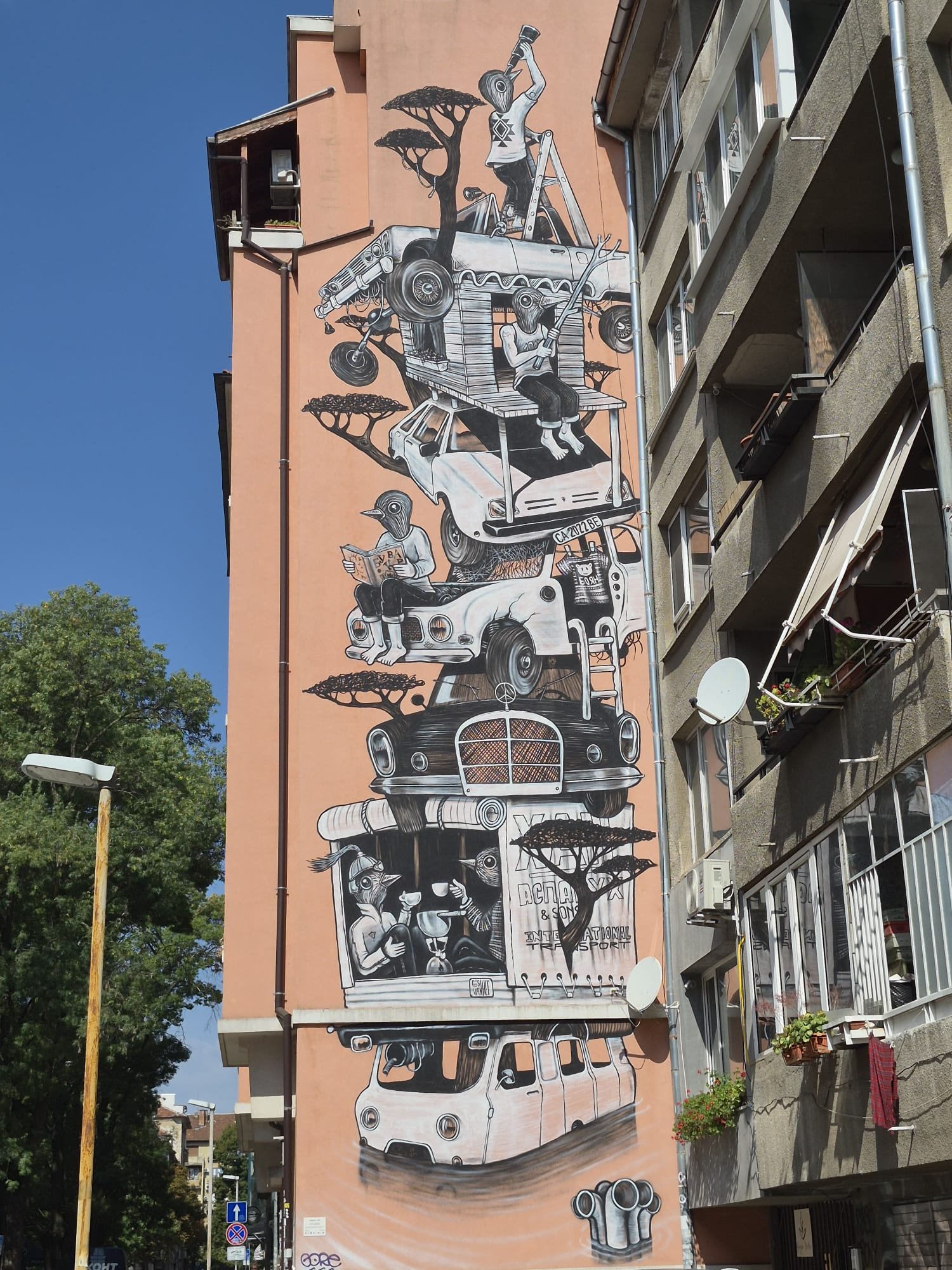
Vanhee’s work is all about freedom, movement and the tension between nature and the society we have built around ourselves. The artist describes the figures as his “free birds”, and Parked Life becomes a story about travellers and dreamers, told through wheels, roads and the clutter of urban life. Spend a few minutes looking at the details rather than simply taking the obligatory photograph.
Before you leave, if you need coffee, you’re already in a useful spot. Black Label Coffee House and Bakery is just down Han Asparuh at number 13, making it an easy place to fuel up before continuing.
From here, head south-east towards the historic centre. Within a few minutes you’ll arrive at something much more mythological.
Stop 2: Saint George and the Dragon
ul. Triaditsa 6
This one is difficult to miss.
Painted across the side of a tall building, Bozko’s enormous Saint George and the Dragon turns a familiar legend into something almost surreal in scale. Saint George occupies the foreground, his back turned towards us, while the enormous red dragon towers above him.
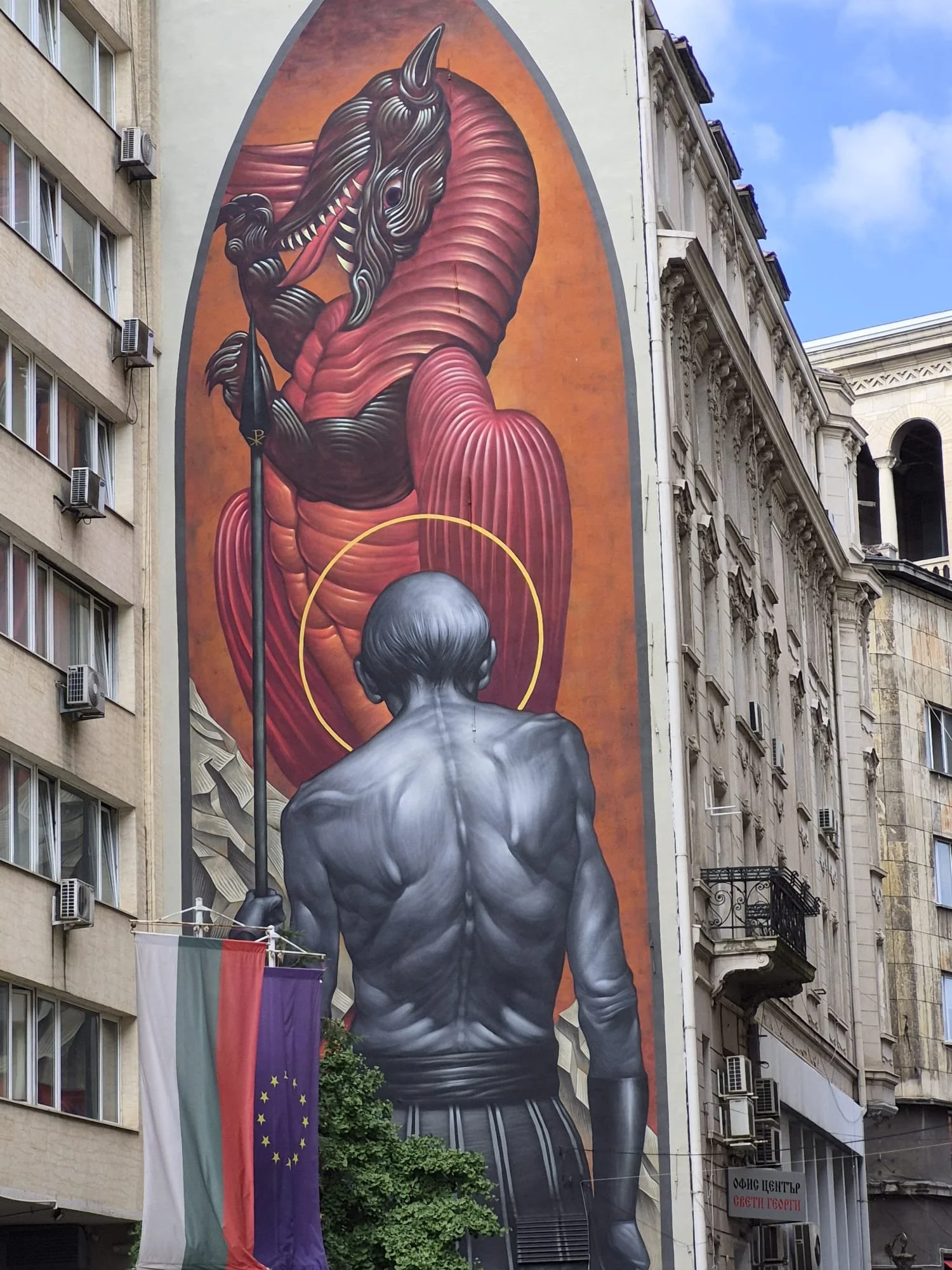
It’s a striking example of how Sofia’s street art can borrow from much older visual traditions. This isn’t simply an abstract piece of graffiti squeezed onto an empty wall. It takes a story represented in religious art for centuries and gives it a monumental, contemporary form. The mural is one of Bozko’s works for the Urban Creatures project.
From here, continue towards Maria Luisa Boulevard and Serdika. You are heading into one of the city’s best-known concentrations of street art, and the atmosphere changes again.
Stop 3: Serdika Tulip
Knyaginya Maria Luisa Boulevard 19
Eventually you’ll reach the enormous face of a woman in a blue hat, surrounded by flowers.
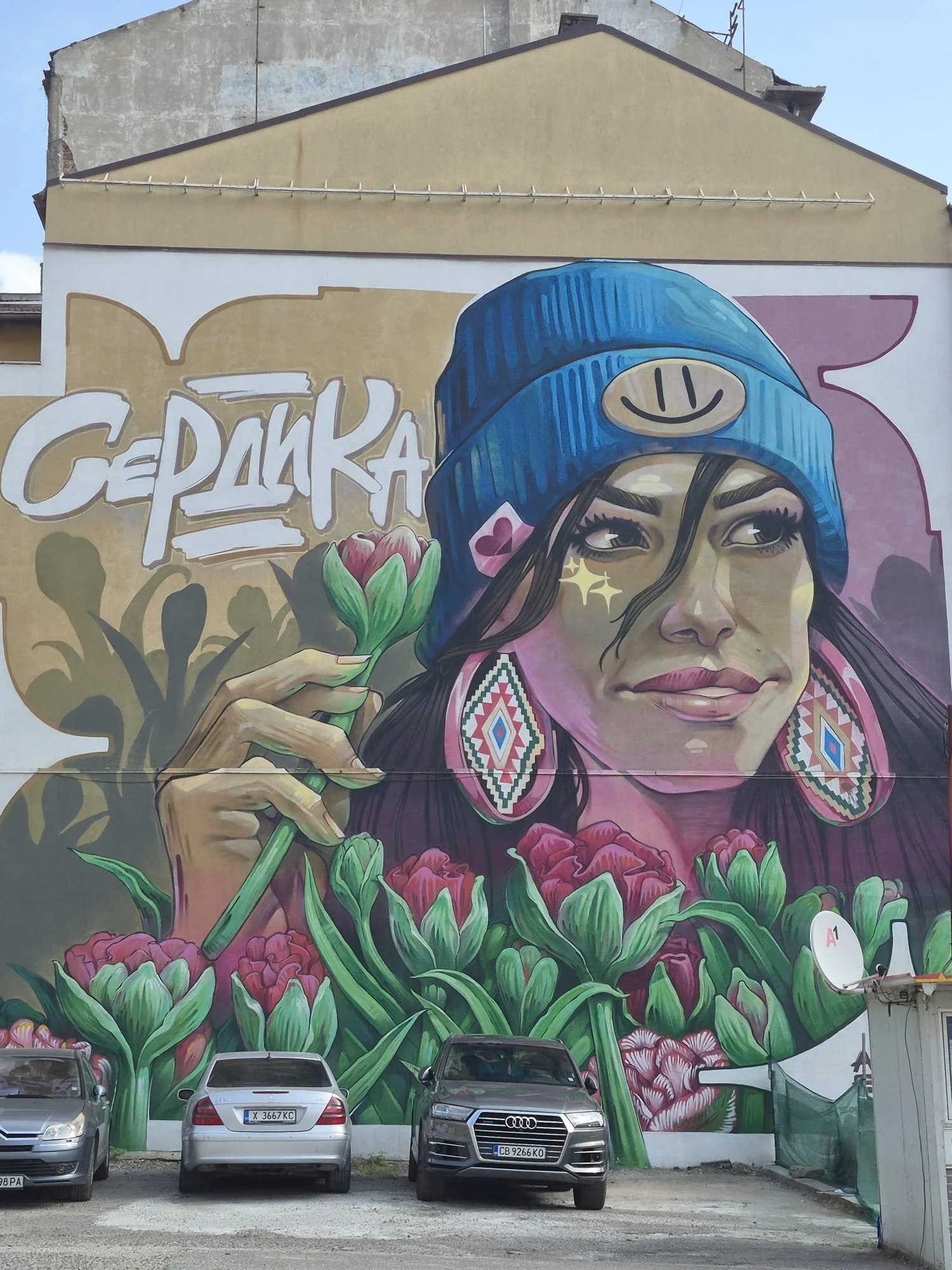
This is Serdika Tulip, created by Bulgarian artists Arsek & Erase in 2020. The 200-square-metre mural was commissioned as part of an initiative between the Dutch Embassy in Bulgaria and Sofia Graffiti Tour, celebrating the relationship between Bulgaria and the Netherlands.
The tulip at the centre isn’t arbitrary, either. The artists incorporated the specially developed ‘Serdika’ tulip, named after the ancient city beneath modern-day Sofia.
I like this mural because it feels both enormous and oddly intimate. From a distance, it is another giant piece of urban colour. Up close, you start noticing the jewellery, the expression, the flowers and the small details that make the face feel almost like a portrait rather than a wall.
This is also a good place to pause and look around you. The parking area beneath and around the mural is one of Sofia’s established graffiti spots, with several works hidden between the parked cars.
Stop 4: The Chupa Chups graffiti zone
Maria Luisa Boulevard, around the parking area at No. 13
Look for the old, peeling Chupa Chups advertising mural, designed by Salvador Dalí. The advertisement itself is now faded and weathered, but beneath it and around the neighbouring walls, Sofia’s contemporary street-art scene has layered itself onto the city.
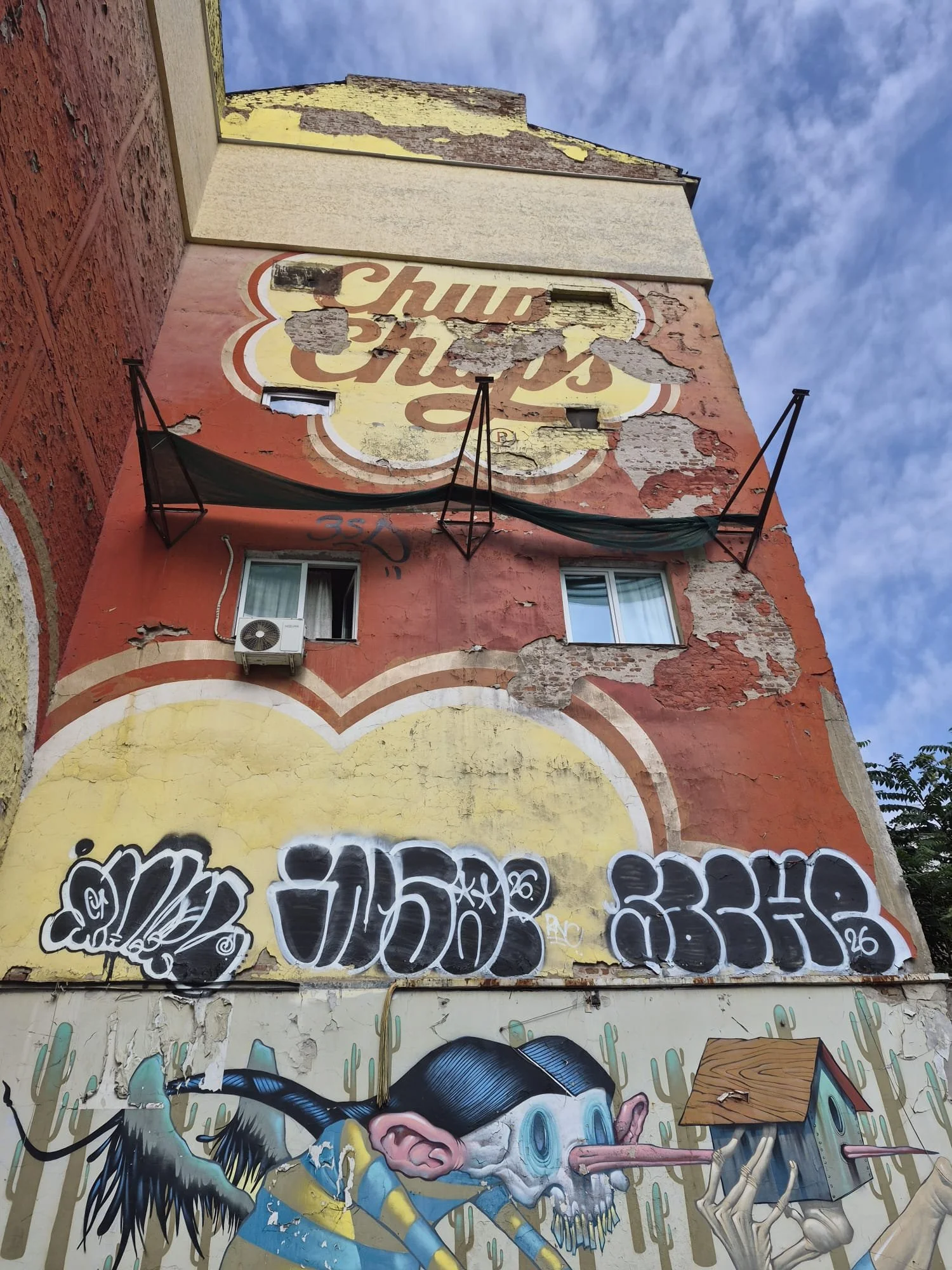
There is more to discover than the particular mural that brought you here. This is less a single artwork than a little outdoor gallery, constantly changing as old pieces weather and new ones appear.
It is also one of the places that most clearly captures what interested me about Sofia in the first place: the way art isn’t always separated neatly from everyday life. It sits behind parked cars. It shares walls with advertisements. It appears around utility boxes, broken windows, and bits of infrastructure that nobody thought particularly beautiful until somebody decided to paint them.
When you’re ready, leave the parking area and head north-west into the old Jewish Quarter.
Stop 5: The Embrace/Hug
ul. Bacho Kiro 29
Here, the buildings become older and more worn. The streets narrow, with cafés, workshops and small businesses appearing alongside peeling façades. Tucked into this urban fabric, you’ll find The Embrace, painted by Bulgarian artist Stanislav Trifonov, better known as Nasimo, one of the country’s most prominent street artists.
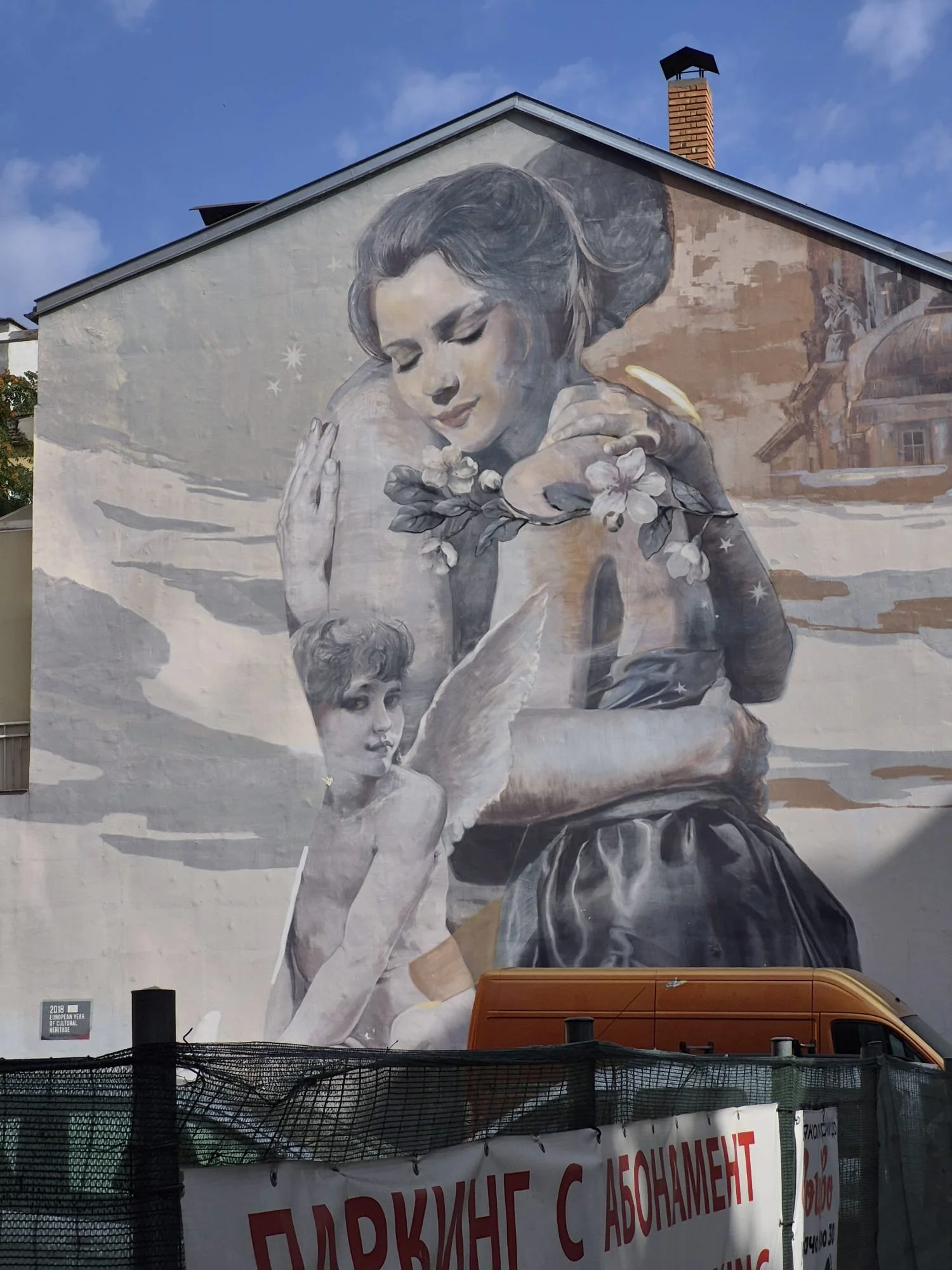
It depicts two figures wrapped around one another, with a small Cupid-like figure watching from below. Created in 2018 and dedicated to Sofia Day, 17 September, sometimes you’ll see it called simply Hug; at other times, The Embrace.
This mural feels gentler than some of the pieces you’ve already passed. After the monumental Saint George, this one feels almost more private.
Stop 6: The Dance of Bread Rolls / Charlie Chaplin
Bacho Kiro Street
Continue along Bacho Kiro and look for the black-and-white mural of Charlie Chaplin.
The image shows Chaplin with one of his famous bread rolls, referencing the celebrated scene from The Gold Rush, in which his character imagines the bread rolls dancing like ballet shoes. The scene itself is a lovely example of Chaplin transforming something completely ordinary into something magical.
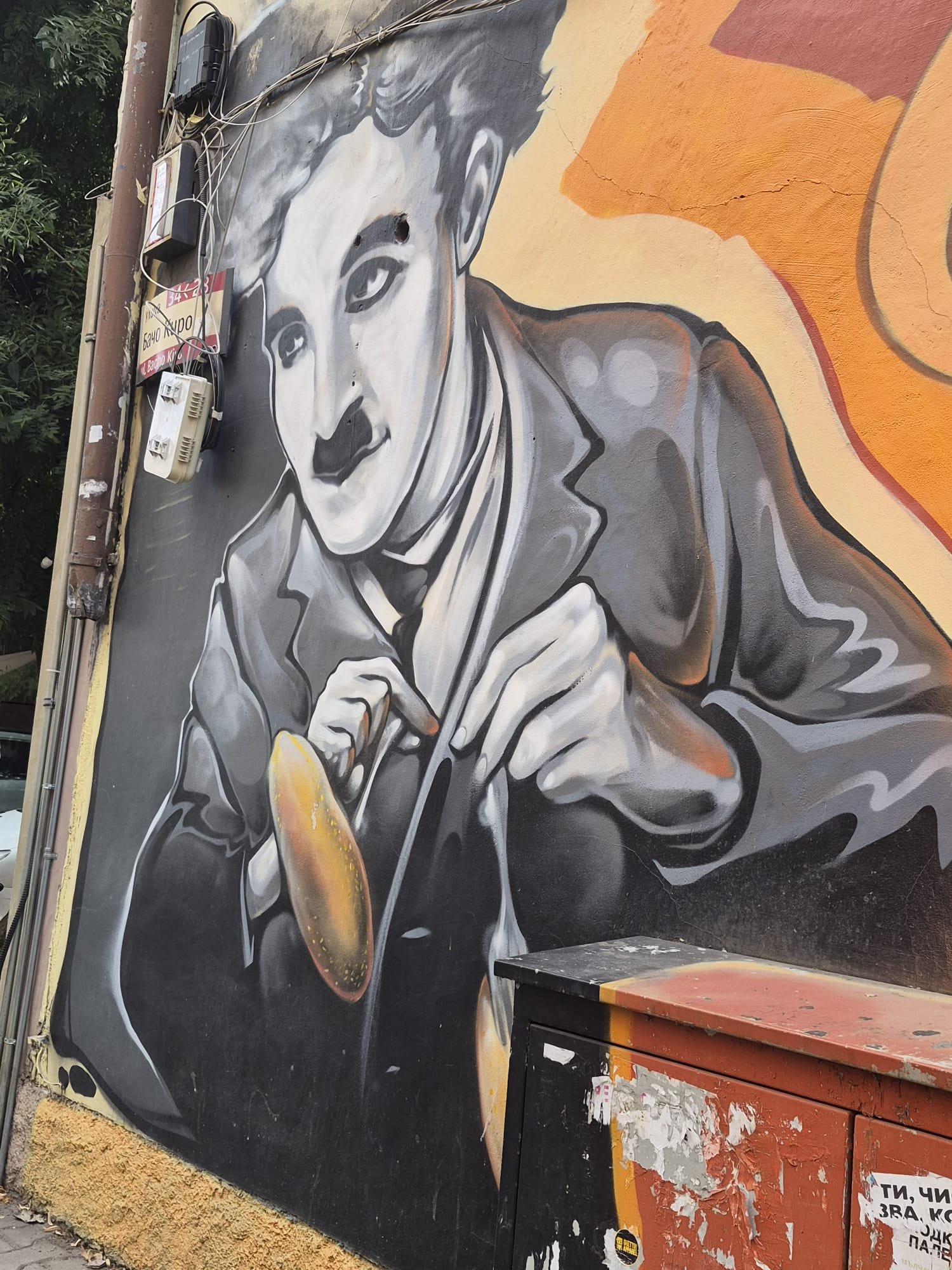
The work is associated with MAD, or Me After Daylight, and is often called The Dance of Bread Rolls.
You’re also now properly within KvARTal, Sofia’s old Jewish Quarter, where the art isn’t confined to a single designated gallery or street. The wider neighbourhood is characterised by old architecture, small businesses, galleries, cafés and bars, with street art woven through it.
If you fancy stopping for a sweet treat rather than simply marching onwards, this is a good part of the walk to do it. Bloom Specialty Coffee on Veslets 23 is particularly convenient to the route, while BABKA Coffee & Buns is just a few doors away at Veslets 13.
Then, when you’re re-energised, carry on towards Paris Street.
Stop 7: Creator and His Battles
ul. Paris 5
This might be one of my favourites.
The mural is by Bozhidar Simeonov, known as Bozko, and was created for the 2019 Urban Creatures project, whose theme that year was “Creator and His Battles”.
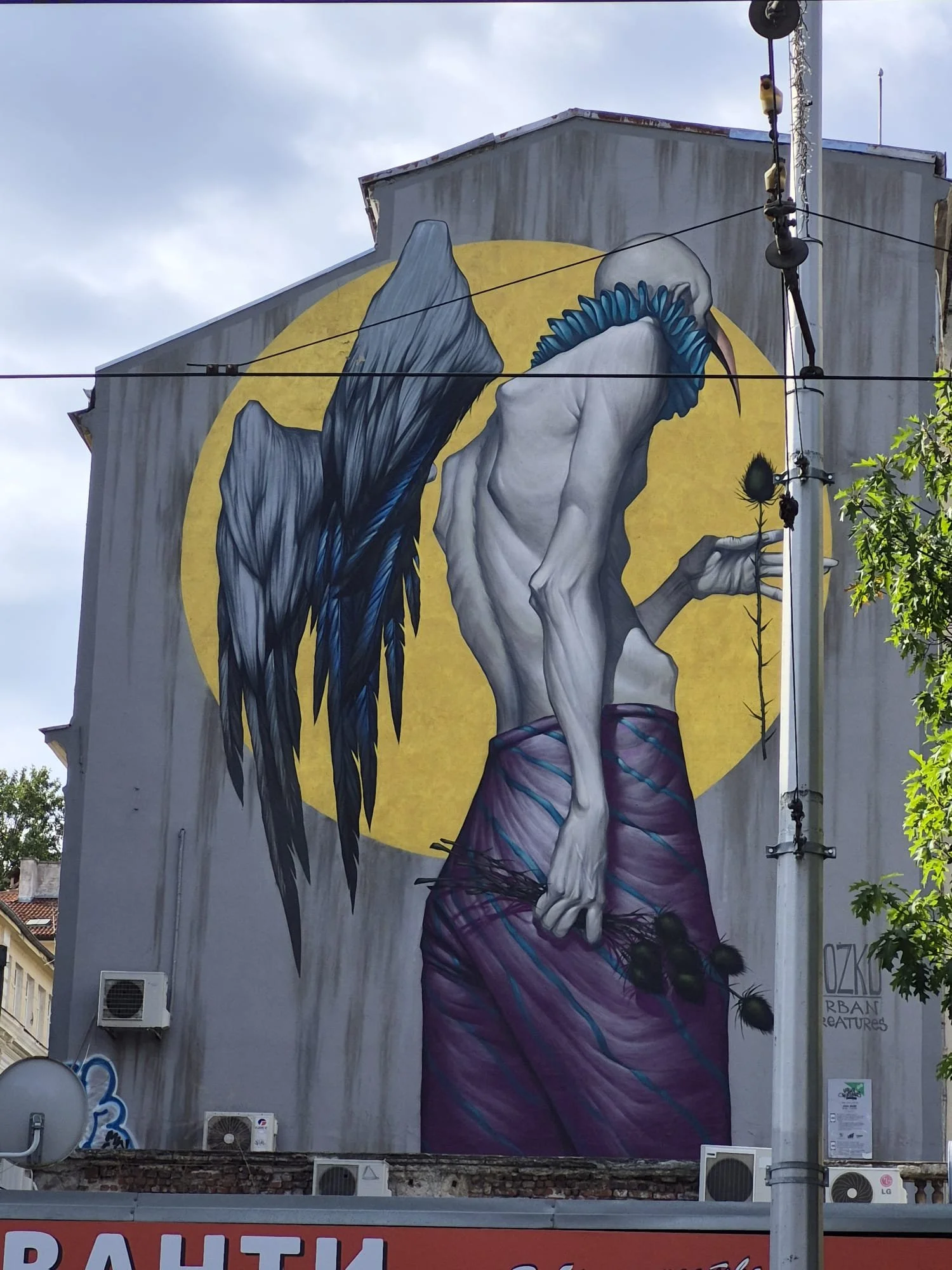
‘The image is unsettling. A huge, almost ghostly figure occupies the wall, while hands reach towards the body from below and around it. The central figure appears vulnerable, despite its enormous size, as though the artist has turned the wall into a physical representation of what it feels like to create something and then have the world press in around it.
The work asks questions about the reality artists inhabit: whether the world around them has become distorted, whether artists become tired of their own wings, and whether they receive thorns instead of flowers.
It is worth knowing this before you see it, because otherwise it would be easy to simply look and move on.
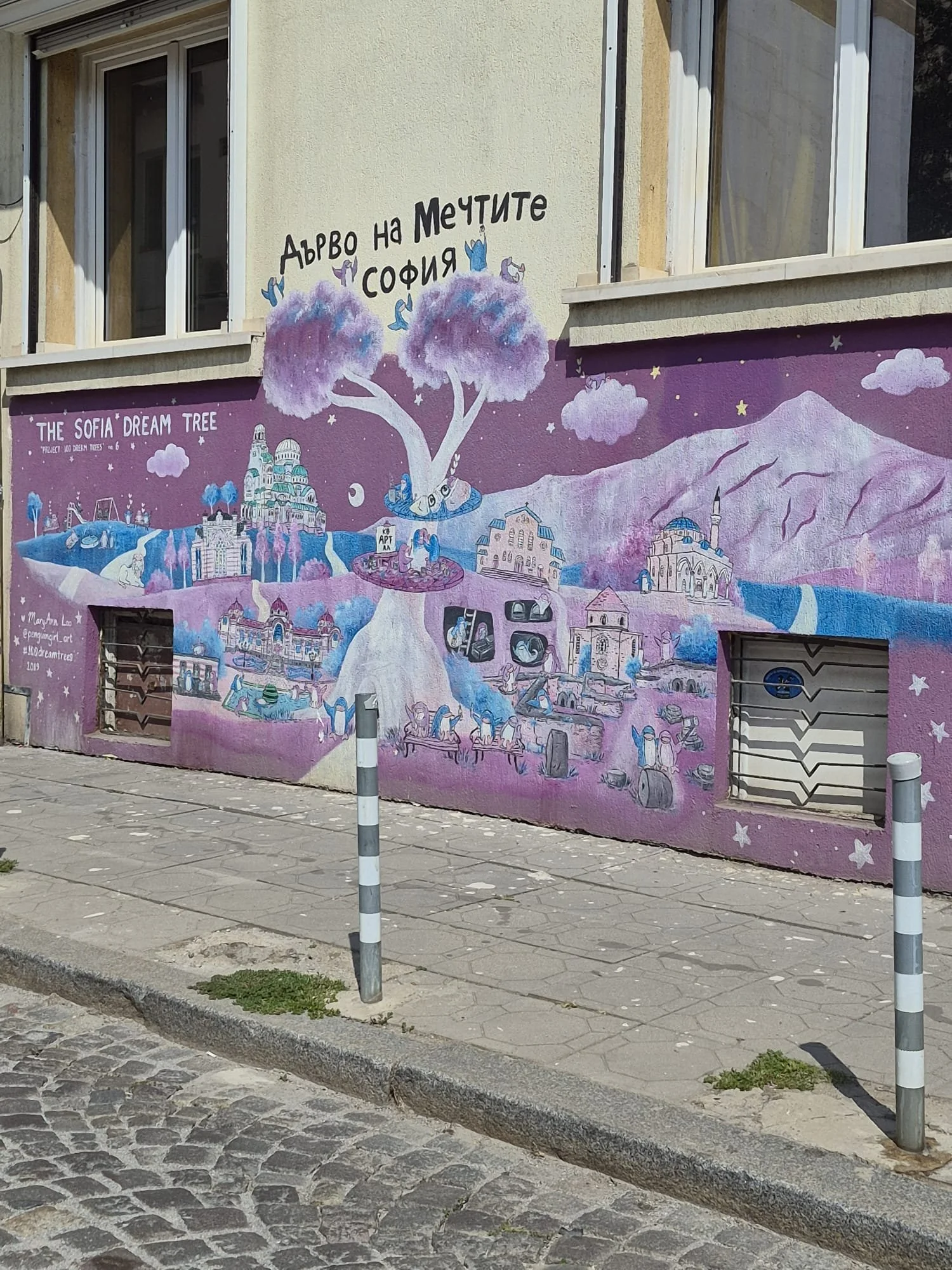
Stop 8: The Sofia Dream Tree
ul. Tsar Simeon 60
From Paris Street, stroll towards Tsar Simeon, where the vibe of your surroundings starts to shift.
The old Jewish Quarter has a slightly different rhythm to the grander streets of central Sofia. There are residential buildings, peeling façades, balconies, tiny businesses, and traces of different eras on top of one another. The guide describes the neighbourhood as increasingly becoming a cultural centre, with its pre-war architecture providing much of its character.
And then you find a dream tree.
The Sofia Dream Tree was painted in 2019 by Singaporean artist MaryAnn Loo as part of her project 100 Dream Trees. The mural imagines Sofia’s landmarks and landscapes growing out of an enormous tree, surrounded by birds, clouds and tiny figures. It feels almost deliberately at odds with the buildings around it.
The idea of putting a dream tree onto an ordinary residential façade is rather childlike, but the longer you look, the more recognisable Sofia becomes within it. The city has effectively transformed into a storybook.
Stop 9: The Woman in the Yellow Dress
ul. Iskar 11B
Keep heading through the old Jewish Quarter towards Iskar Street.
Here, another enormous figure emerges from the buildings: a woman in a yellow dress, holding an American football helmet.
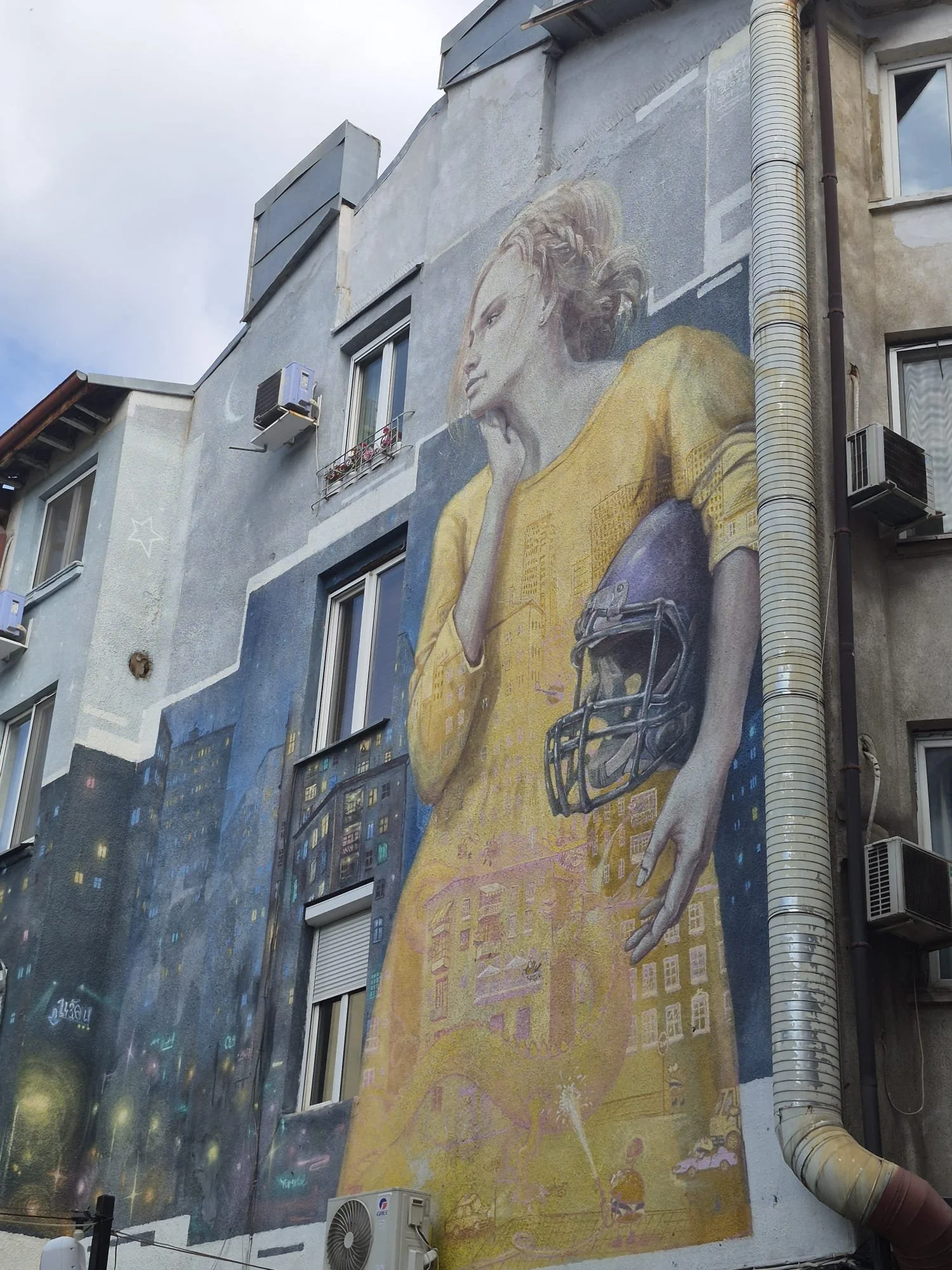
The mural is by Bulgarian artist Dimitar Mehandjijski, known as Stern, called The Woman in the Yellow Dress. The guide identifies both the artist and the unusual subject matter, while placing the mural within the old Jewish Quarter.
The woman appears to be contemplating the world around her, while the surrounding city is just continuing to live in the background.
Stop 10: The Candle
ul. Iskar 27
A short walk further along Iskar brings you to another piece that isn’t in my own photograph collection, but which I think deserves a place on this route.
It is enormous and deceptively simple: a candle painted across the wall of a building. If you look closely at the flame and inside, you’ll see there are tiny human figures; they are firefighters.
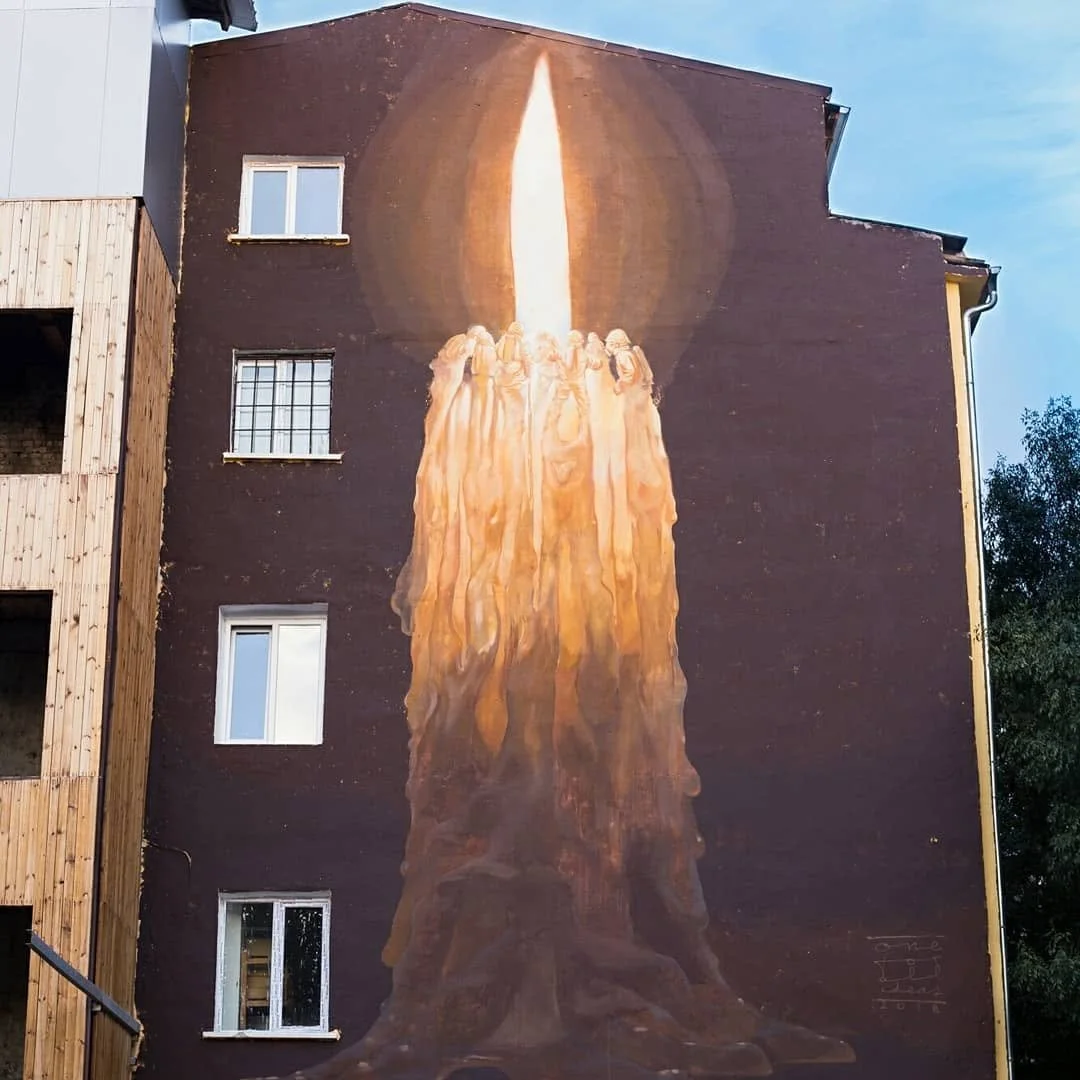
The mural was created by the collective 140 Ideas, whose members, Wenzi, Ivo, Nicky and Lucy, describe their name as meaning “One For All ideas”. The work was created as part of the wider effort to turn the old Jewish Quarter into an art space.
A candle usually symbolises light, hope or remembrance. Here, that light contains people working together.
Stop 11: The Nineties
Hadzhi Dimitar
The last stop is deliberately different.
Leave the old Jewish Quarter behind and head towards Hadzhi Dimitar, one of Sofia’s recognised graffiti neighbourhoods.
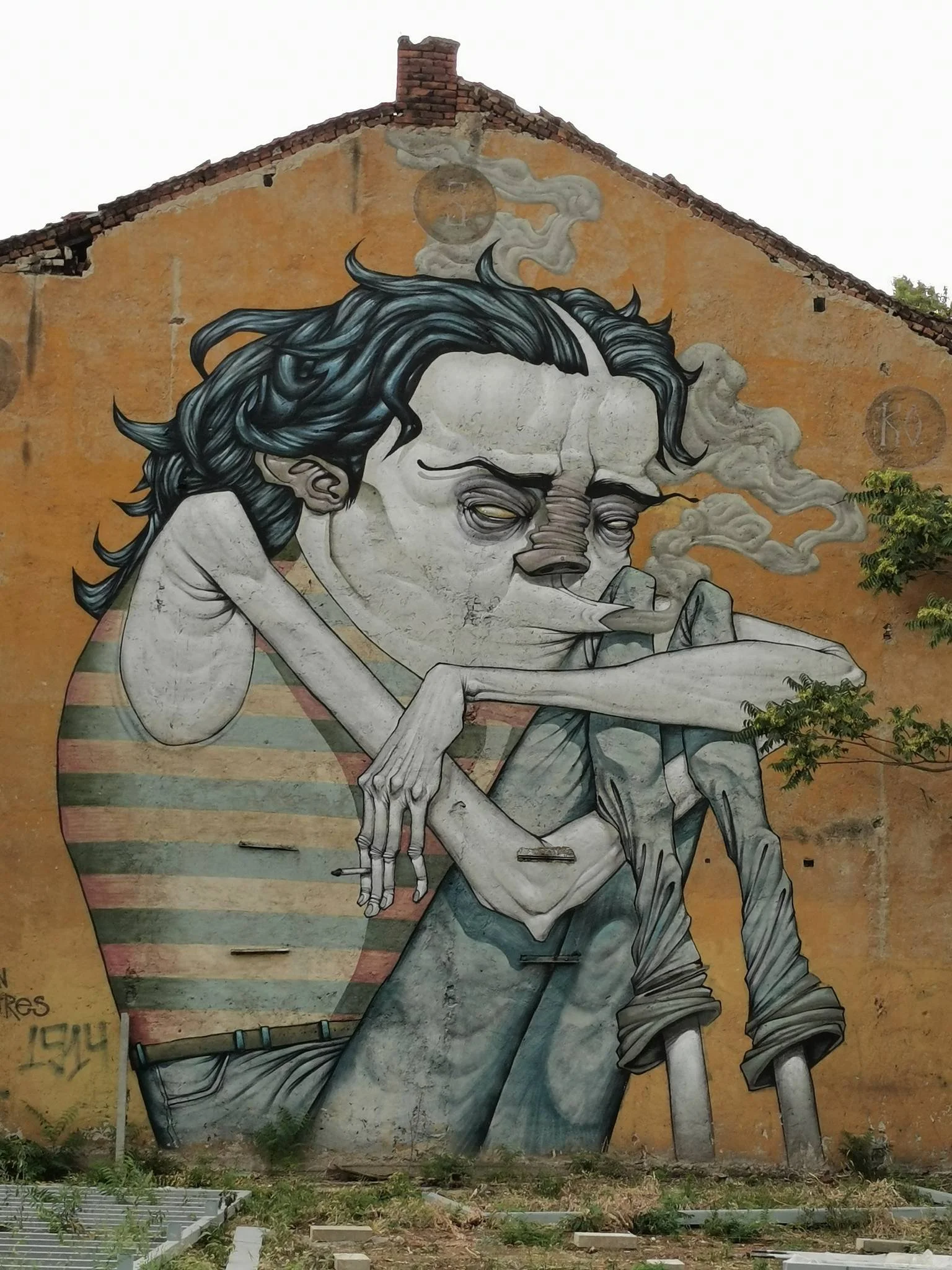
This is home to The Nineties, another large-scale work by Bozko, created in 2015. The mural belongs to a much wider concentration of street art in the neighbourhood, where old residential blocks have gradually become enormous canvases.
The guide describes Hadzhi Dimitar as a “Graffiti Quarter”, with more than ten interesting graffiti sites spread through the residential complex. It also notes that the first three blocks were painted in 2013 and that the works are close enough together to explore on foot.
You’ll notice a painted door or a strange figure on the side of a block. You’ll wonder what is around the corner. You’ll start scanning the tops of buildings rather than just the shopfronts in front of you, and that’s really the point of this route. That makes Hadzhi Dimitar a fitting place to end rather than simply another stop to tick off.
A final note
This route is not definitive. That would be impossible because I definitely didn’t see every piece of graffiti Sofia has to offer.
In addition, Sofia’s street art is always changing. Some of the street art has weathered over time, with new ones always appearing. Others disappear beneath paint, renovations, or when a building gets demolished. Some are tucked into car parks, courtyards, and side streets that I didn’t venture down, and some I couldn’t confidently pin to a location.
Instead, think of this as a whistle-stop tour: a selection of the pieces that caught my eye, connected into a route that lets you experience a little of the city between them.
The point isn’t to find every mural, but to find the ones that make you stop. Perhaps you’ll turn a corner halfway through the route and find something I never photographed. I really hope you do.
If there is one thing I took away from wandering around Sofia with a camera, it is that the most interesting parts of a city aren’t always the ones you are told to look for.
If you visit Sofia and follow this walking tour, please give your feedback. It took a while to reverse-engineer a walking tour that began with a mere bunch of pictures of art I thought was cool on my phone. I’m determined to make this a comprehensive and easy-to-navigate guide, so any comments that improve this or make it simpler are welcome!
Book your next trip with me!
Whether you're planning a big bucket-list adventure, a romantic escape, a family holiday, a city break or simply need someone else to take the stress out of finding the right trip, I love putting all the little pieces together.
So, why not get in touch? And lets start making those dreams your next destination.
